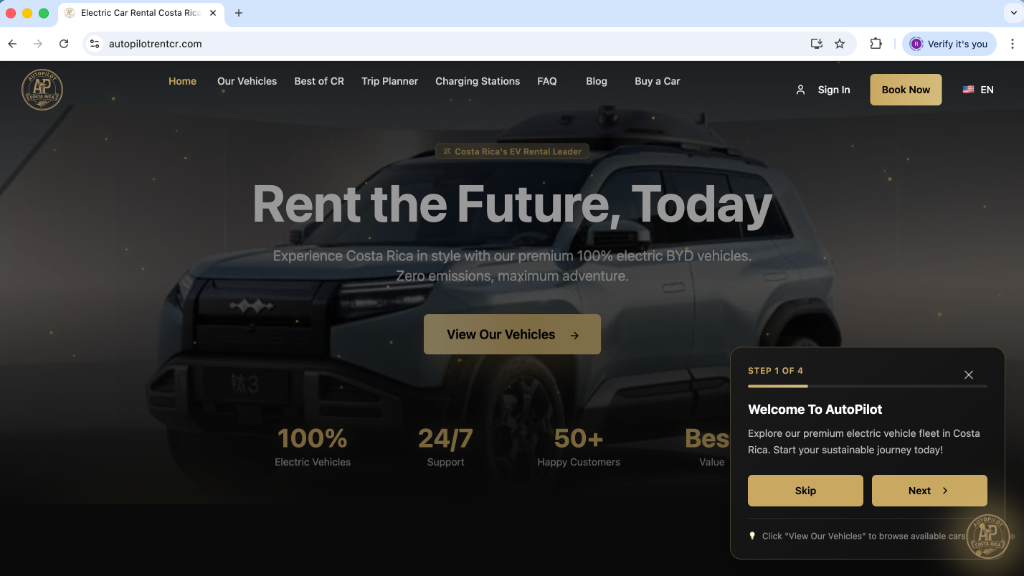
From Zero to Launch in 10 Days: How We Built AutoPilotRent's Platform
When Rodrigo from AutoPilotRent CR first reached out to us, he had a clear challenge: Costa Rica's premier electric vehicle rental company needed a website that matched the quality and innovation of their fleet. A simple template wouldn't cut it. He needed something that solved a real problem — range anxiety.
Ten days later, we launched.
Here's how we did it.
Day 1–2: Discovery & Strategy
We didn't start by opening a design tool. We started by understanding the business.
The core insight that shaped everything: the #1 reason people don't rent EVs isn't price — it's fear of running out of charge.
This meant the website's primary job wasn't just to look good and take bookings. It needed to actively eliminate that fear. Every design decision, every feature, every piece of content was built around this insight.
Key decisions made in Day 1:
- Primary CTA: Not "Book Now" but "Plan Your Trip" — lower friction, more educational
- Feature priority: Charging station map and AI trip planner above the fold
- Bilingual from day one: English for international tourists, Spanish for locals
Day 2–4: Design & Architecture
We built AutoPilotRent's design system from scratch — a luxury dark theme with gold/amber accents that matched their premium BYD vehicle fleet. No generic templates.
The information architecture was complex:
- Public website with 6+ pages
- Vehicle fleet catalog with advanced filtering
- Interactive charging station map (53 stations across Costa Rica)
- AI trip planner with 8 input parameters
- "Best of Costa Rica" destination guide
- Admin CRM dashboard for fleet management
With modern AI development tools, what would have taken a team weeks was compressed into days.
Day 4–7: Development Sprint
This is where the AI-powered development approach truly shines.
The charging station map alone would have taken a traditional developer 2 weeks. We integrated Leaflet/OpenStreetMap, connected to Costa Rica's official ICE charging network API, built custom filtering (by charger type, speed, compatible vehicles), and added GPS "show my location" functionality — in 2 days.
The AI trip planner was the crown jewel. Users input their destinations, trip duration, travel companions, interests, and budget. The LLM engine generates a personalized, EV-optimized day-by-day itinerary with charging stops, activity recommendations, and eco-impact data. Complex? Yes. But with AI tooling, we shipped it in 3 days.
Day 7–9: Testing & Optimization
We don't just build — we optimize. Every page was tested for:
- Core Web Vitals (Google's performance metrics)
- Mobile responsiveness across 15 device sizes
- Bilingual consistency (every UI element in both English and Spanish)
- AI chatbot response quality (100+ test queries)
- Charging station data accuracy
Day 10: Launch
The site went live. Not a "soft launch" — a real launch with proper SEO metadata, structured data, sitemap submission, and a full onboarding walkthrough for Rodrigo's team.
The Results
The numbers speak for themselves:
- Range anxiety: Eliminated — 53+ charging stations visible on an interactive map
- Trip planning complexity: Solved by AI — personalized itineraries in seconds
- Booking confidence: Dramatically increased — EV suitability ratings for every destination
- Bilingual market: Fully served — complete English/Spanish experience
Most importantly, AutoPilotRent now has a digital presence that matches the quality of their vehicles.
What This Means for Your Business
The AutoPilotRent story isn't unique. Every business has a core insight — a specific fear or friction point that prevents potential customers from converting. Our job is to find it, build around it, and ship fast.
10 days. One AI-powered agency. A platform that would have cost $30,000+ from a traditional agency.