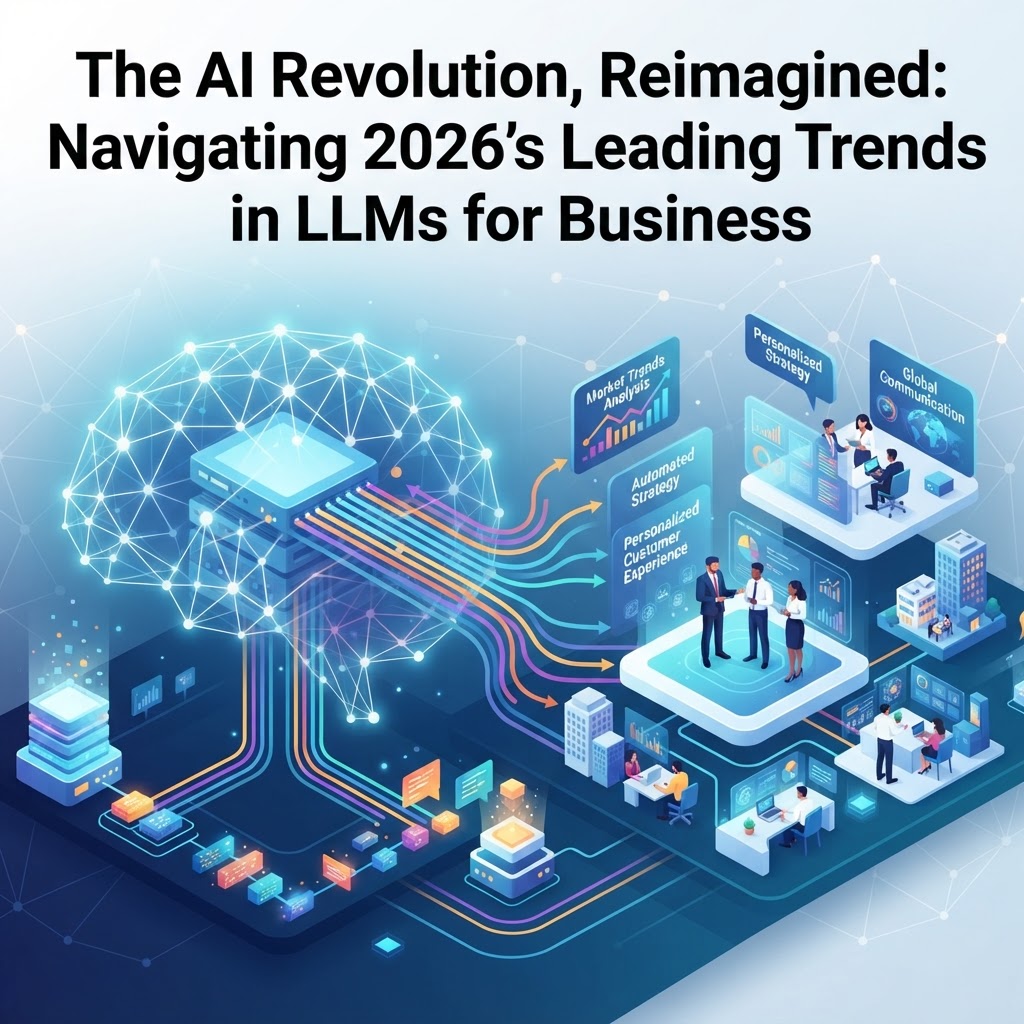
The AI Revolution, Reimagined: Navigating 2026's Leading Trends in LLMs for Business
The year is 2026, and the conversation around Artificial Intelligence (AI) has moved beyond theoretical potential to tangible, business-driving realities. At the forefront of this transformation are Large Language Models (LLMs), sophisticated AI systems capable of understanding, generating, and manipulating human-like text and code. For business owners and tech professionals, understanding and strategically adopting these evolving LLM trends is no longer an option, but a critical imperative for growth, efficiency, and competitive advantage.
This post explores the most significant LLM trends shaping the business world in 2026, providing practical insights and actionable advice to help you leverage these powerful tools.
1. Hyper-Personalization at Scale: Beyond Basic Segmentation
LLMs have supercharged personalization efforts, enabling businesses to connect with customers on an individual level like never before. In 2026, this goes far beyond simply addressing a customer by their name.
What's Trending:
- Dynamic Content Generation: LLMs can now craft marketing copy, product descriptions, and even personalized email campaigns that adapt in real-time based on a user's browsing history, past purchases, and expressed preferences. Imagine a customer browsing for hiking gear; an LLM can generate a product recommendation that not only highlights relevant items but also tailors the language to their presumed interest (e.g., focusing on durability for a seasoned hiker, or ease of use for a beginner).
- AI-Powered Customer Service Avatars: Advanced chatbots, powered by LLMs, are becoming indistinguishable from human agents in many scenarios. They can understand complex queries, access vast knowledge bases, and respond with empathy and accuracy, offering 24/7 support tailored to individual customer needs and past interactions.
- Personalized Learning and Development: Within organizations, LLMs are being used to create bespoke training modules, recommend relevant internal resources, and even provide individualized feedback to employees, accelerating skill development and engagement.
Actionable Advice:
- Invest in Data Infrastructure: Effective hyper-personalization relies on high-quality, well-organized customer data. Ensure your CRM and data lakes are robust and accessible.
- Pilot LLM-driven Content Tools: Experiment with generative AI platforms for marketing and sales content. Start with smaller campaigns and measure the impact on engagement and conversion rates.
- Integrate LLMs into Customer Support: Evaluate LLM-powered chatbot solutions to augment or even automate Tier 1 customer support, freeing up human agents for more complex issues.
2. Generative AI for Code and Content Creation: Boosting Productivity
The ability of LLMs to generate human-quality content and code has exploded, fundamentally altering workflows in creative and technical fields.
What's Trending:
- Advanced Code Generation and Debugging: LLMs are now adept at writing boilerplate code, suggesting optimizations, identifying bugs, and even translating code between languages. This dramatically speeds up software development cycles.
- AI-Assisted Creative Writing: From drafting blog posts and social media updates to generating marketing slogans and scripts, LLMs are becoming indispensable tools for content creators.
- Synthetic Data Generation: For training AI models, especially in areas with limited real-world data, LLMs can generate realistic synthetic datasets, accelerating the development of specialized AI applications.
Example: A software development team can use an LLM to generate initial code for a new feature, allowing developers to focus on complex logic and innovation rather than repetitive coding tasks. Similarly, a marketing team can use an LLM to brainstorm headline variations for a new campaign, generating dozens of options in minutes.
Actionable Advice:
- Integrate LLMs into Development Pipelines: Explore LLM tools that can assist with code completion, documentation generation, and automated testing.
- Establish Content Creation Guidelines: While LLMs can generate content rapidly, human oversight is crucial for brand voice, factual accuracy, and strategic alignment. Develop clear guidelines for AI-generated content.
- Train Your Teams: Equip your employees with the skills to effectively prompt and utilize LLM tools for content and code generation.
3. Multimodal AI: Understanding the World Beyond Text
While LLMs initially focused on text, 2026 sees a significant leap towards multimodal AI, where models can process and understand information from various sources simultaneously – text, images, audio, and video.
What's Trending:
- Visual Content Analysis: LLMs can now interpret images and videos, enabling applications like automated image tagging, video summarization, and even sentiment analysis from visual cues.
- Voice-to-Text and Text-to-Voice Enhancement: Improved understanding and generation of spoken language, leading to more natural and sophisticated voice assistants and transcription services.
- Cross-Modal Search: Users can search for information using a combination of inputs. For instance, uploading an image of a product and asking a text-based question about it.
Example: A retail company could use multimodal AI to analyze customer-uploaded photos of product usage, identify potential issues, and provide targeted support or product recommendations. A real estate agency could generate detailed property descriptions by analyzing photos and floor plans.
Actionable Advice:
- Explore Multimodal Data Opportunities: Identify areas where combining text, image, or audio data can unlock new insights or create novel customer experiences.
- Consider AI for Multimedia Content Moderation: LLMs can help automate the review of images and videos for inappropriate content, improving safety and compliance.
- Enhance Accessibility: Multimodal AI can generate descriptive text for images or create audio descriptions for videos, making content more accessible.
4. AI Agents and Autonomous Systems: Driving Automation
LLMs are evolving from passive tools to active agents capable of performing multi-step tasks autonomously to achieve defined goals.
What's Trending:
- Automated Workflow Orchestration: AI agents can now manage complex workflows, such as booking travel, scheduling meetings, processing invoices, and even conducting preliminary market research, by interacting with various software applications.
- Proactive Problem Solving: Agents can monitor systems, identify potential issues before they escalate, and initiate corrective actions. For example, an AI agent managing a cloud infrastructure could detect performance degradation and automatically scale resources.
- Personalized Digital Assistants: Beyond simple chatbots, these agents can act as proactive personal assistants, anticipating needs and taking action without explicit commands.
Example: An AI agent could be tasked with planning a business trip. It would autonomously search for flights and hotels based on predefined criteria, book the best options, add them to the calendar, and generate an itinerary, all without human intervention.
Actionable Advice:
- Identify Repetitive, Multi-Step Processes: Pinpoint business processes that are ripe for automation by AI agents.
- Prioritize Security and Oversight: As agents gain autonomy, robust security protocols and clear oversight mechanisms are paramount to prevent unintended consequences.
- Start with Defined, Narrow Tasks: Begin by deploying AI agents for well-defined tasks with clear success metrics before expanding to more complex operations.
5. Enhanced AI Governance, Ethics, and Responsible AI
As LLMs become more powerful and pervasive, the focus on responsible development, deployment, and ethical considerations has intensified in 2026.
What's Trending:
- Explainable AI (XAI) for LLMs: Increased demand for transparency in how LLMs arrive at their decisions, especially in critical applications like finance and healthcare.
- Bias Detection and Mitigation: Advanced techniques and frameworks are being developed to identify and reduce biases within LLM training data and outputs.
- Robust Security Frameworks: Protecting LLM models from adversarial attacks, data poisoning, and unauthorized access is a top priority.
- Regulatory Compliance: Governments worldwide are implementing stricter regulations around AI usage, data privacy, and algorithmic accountability.
Actionable Advice:
- Establish an AI Ethics Board or Framework: Develop internal guidelines for the ethical development and deployment of AI technologies.
- Prioritize Data Privacy and Security: Ensure all LLM implementations comply with relevant data protection regulations (e.g., GDPR, CCPA, and emerging global standards).
- Invest in Explainability Tools: When deploying LLMs in sensitive areas, look for solutions that offer insights into the model's decision-making process.
- Stay Informed on Regulations: Keep abreast of evolving AI legislation and adapt your AI strategies accordingly.
Conclusion: Embracing the Future, Responsibly
The trajectory of LLMs in 2026 is one of increasing sophistication, pervasive integration, and growing autonomy. From hyper-personalized customer interactions and accelerated content creation to multimodal understanding and autonomous agents, these technologies offer unprecedented opportunities for businesses to innovate, optimize, and lead. However, with this power comes the responsibility to deploy AI ethically, securely, and with a clear understanding of its implications.
By staying informed about these trends and proactively integrating them into your business strategy, you can harness the full potential of LLMs to drive growth, enhance efficiency, and secure a competitive edge in the evolving digital landscape.