Skip to content
Back to Insights
ai llmAugust 20, 20263 min read

The 2026 AI Frontier: Strategic Imperatives for Modern Business

Explore the critical AI and LLM trends defining the 2026 business landscape, from autonomous agent architectures to edge-deployed intelligence.
Share:
The 2026 AI Frontier: Strategic Imperatives for Modern Business

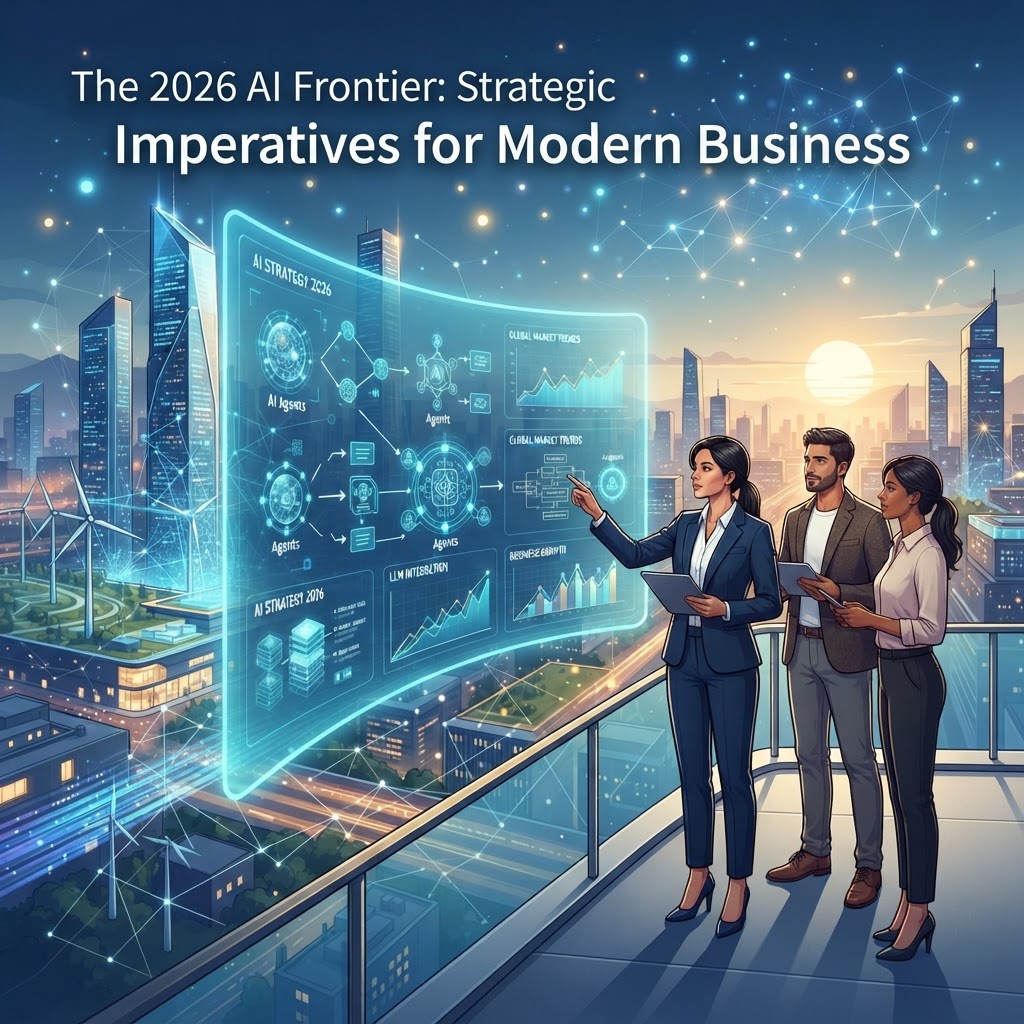
The Shift to Autonomous Agency In 2026, the conversation around AI has evolved from simple content generation to the era of Autonomous Agents. Business leaders are no longer looking for mere chatbots but for systems capable of complex decision-making, end-to-end task execution, and cross-platform orchestration. By leveraging agentic frameworks, companies can now automate entire workflows—such as supply chain procurement or personalized customer retention cycles—without human intervention in every loop. ### From Chat to Action The primary shift is the transition from 'co-pilots' that suggest answers to 'agents' that perform work. In practice, this means integrating LLMs with specialized tool-calling capabilities. For example, a marketing agency in 2026 uses agents that draft content, check inventory databases, adjust ad bids in real-time, and report results without a single copy-paste action from a human staffer. ## The Rise of Small Language Models (SLMs) While massive models continue to push the boundaries of reasoning, the business world has shifted its focus to Small Language Models (SLMs). These models are highly specialized, cost-effective, and designed for edge deployment. They offer lower latency and higher data privacy, which is crucial for organizations dealing with sensitive intellectual property. ### Practical Implementation Strategies Businesses should adopt a 'hub-and-spoke' architecture. Keep your 'hub' (the foundational, large-scale LLM) for complex reasoning tasks, but deploy 'spoke' SLMs locally or within private clouds for operational tasks. This approach reduces cloud consumption costs by up to 60% and ensures that data never leaves the secure perimeter of your enterprise infrastructure. ## Data Governance and the 'Right to Explanation' By 2026, the regulatory landscape regarding AI has matured. Companies are now legally and ethically required to provide an 'explanation' for AI-driven outcomes, particularly in sectors like finance, insurance, and healthcare. This has made Explainable AI (XAI) and RAG (Retrieval-Augmented Generation) with traceable source attribution the new industry standard. ### Actionable Advice for Business Owners 1. Audit your data quality: No model is better than the data it is fed. Prioritize clean, structured data lakes. 2. Invest in vector databases: If you are not storing your business intelligence in a vector format, your LLMs cannot ground themselves in your specific company history. 3. Build for modularity: The pace of AI evolution is rapid. Use orchestration layers like LangGraph or AutoGen so that you can swap out model backends without rebuilding your entire stack. ## The Future of Human-AI Collaboration The most successful companies in 2026 are not replacing humans with AI; they are augmenting human expertise with 'AI-augmented wisdom.' By automating the mundane, employees are freed to focus on high-level strategy, empathy-driven relationship building, and creative problem-solving. Success is no longer measured by the volume of AI output, but by the quality of business outcomes.

AILLMGPTmachine learning
Limited Time Offer

ReadytoTransformYour
Digital Presence?

Get a comprehensive website and SEO audit - completely free. Discover exactly what's holding your business back online.

Results in 48 hours
No commitment required
Free actionable insights

No commitment required • Results delivered within 48 hours